China’s SMPS Power Supply sector serves industries ranging from factory automation to telecommunications and medical equipment. Many suppliers offer standard models, while others develop units around specific voltage, current, enclosure, or cooling requirements. A compact DIN-rail supply and a high-power rack unit demand different design choices. That difference matters.
This introduction looks at leading Chinese manufacturers through practical buying criteria, rather than treating “top” as a fixed ranking. Supplier capabilities can change, and a prominent product catalog does not reveal every detail. Buyers should compare efficiency data, operating temperature, protection features, documented testing, and relevant certifications. They should also ask how a manufacturer handles samples, customization, production traceability, and after-sales support. These details become tangible when a unit must fit a crowded control cabinet or run through repeated load changes.
Company size alone is not enough. A smaller specialist may respond quickly to a custom request, while a larger manufacturer may offer broader product coverage and stronger production capacity. Still, a polished datasheet is not proof of field reliability. Request current technical documents and clarify test conditions before comparing claims. The sections that follow can help readers identify manufacturers worth evaluating, understand what separates their offerings, and prepare more focused questions before sourcing a power supply. Ranking them perfectly is difficult. The best choice depends on the application, evidence, and support the supplier can actually provide.
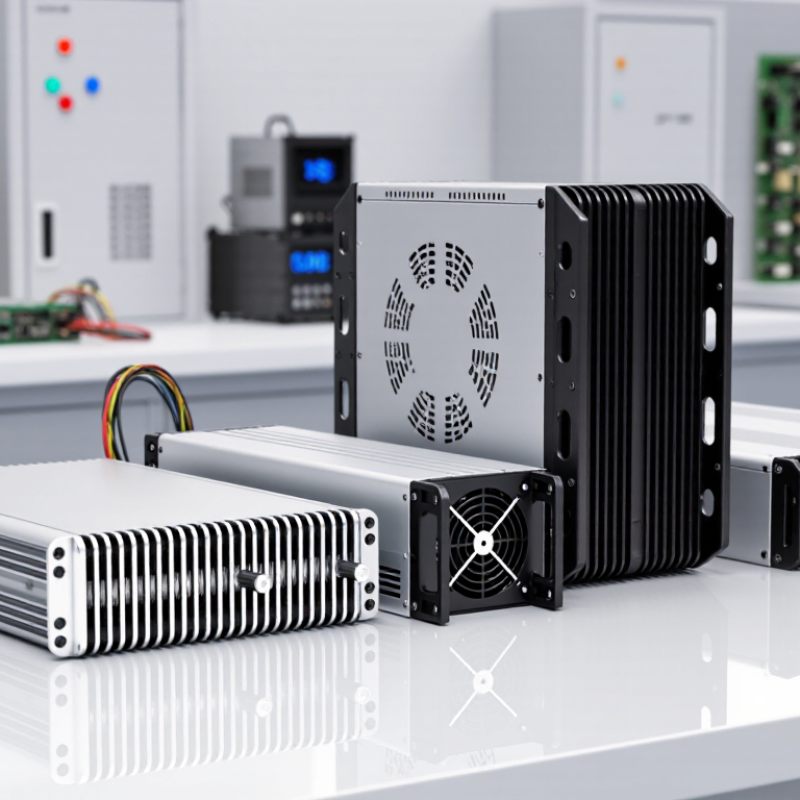
What Is an SMPS Power Supply and How Does It Work?
An SMPS, or switched-mode power supply, converts electrical power into a stable output voltage. Many units accept AC mains power, rectify it into DC, then switch that voltage rapidly using electronic transistors. This high-frequency switching helps reduce transformer size compared with older linear designs. The switched energy passes through a transformer or inductor, then rectifiers and capacitors smooth the output. Feedback circuitry monitors the voltage and adjusts switching to keep it steady as the load changes.
The process is compact, but not effortless. A fanless supply may still run hot inside a sealed cabinet, especially under sustained heavy load. Efficiency depends on design, input voltage, temperature, and how closely the output load matches the unit’s intended range. An SMPS can also produce electrical noise, so sensitive equipment may need suitable filtering and careful wiring. Check the input range, output voltage, current rating, and cooling requirements before choosing a supply.
Tips: Leave space around ventilation openings, and measure the output under the actual load. A quick no-load check is not enough. If readings fluctuate or the case becomes unusually hot, review the wiring and load conditions before continued use.
What Are the Top SMPS Power Supply Manufacturers in China? - What Is an SMPS Power Supply and How Does It Work?
| Category | Comparison Dimension | Typical Industry Information | What Buyers Should Check |
|---|---|---|---|
| China-Based SMPS Manufacturer Capability Profiles | |||
| High-volume OEM/ODM production | Typical product focus | Standardized AC-DC power supplies for consumer electronics, networking equipment, and general-purpose devices. | Production capacity, process controls, product consistency, and the availability of customization. |
| Industrial power supply production | Typical product focus | DIN-rail, enclosed, and open-frame power supplies used in factory automation, control systems, and instrumentation. | Operating temperature range, overload and short-circuit protection, vibration requirements, and applicable safety approvals. |
| LED power supply production | Typical product focus | Constant-current or constant-voltage supplies for lighting applications, including indoor and outdoor installations. | Output regulation, dimming compatibility, ingress protection where needed, and suitability for the intended lighting load. |
| Telecommunications and server power production | Typical product focus | Power conversion products designed for communications infrastructure, data equipment, and other high-uptime systems. | Redundancy options, thermal management, power density, efficiency at the expected load, and service-life documentation. |
| Custom power conversion production | Typical product focus | Application-specific designs with defined input, output, mechanical, or environmental requirements. | Engineering support, prototype and qualification process, design-change control, and ownership of technical documentation. |
| Common manufacturer evaluation | Quality and compliance | Manufacturers may offer products tested against relevant electrical safety, electromagnetic compatibility, and environmental requirements. Requirements vary by product and destination market. | Verify certificates and test reports for the exact model and factory; do not assume that one product’s approvals cover an entire product range. |
| Common manufacturer evaluation | Efficiency and reliability | Efficiency varies by topology, power rating, load, and design. Many modern AC-DC supplies achieve roughly 85%–95% efficiency near specified operating conditions, but the exact figure is model-dependent. | Request efficiency curves, rated-load conditions, protection details, warranty terms, and reliability data for the actual product. |
| SMPS Basics: What It Is and How It Works | |||
| Definition | Switched-mode power supply (SMPS) | An electronic power supply that regulates and converts electrical power by switching semiconductor devices at high frequency. | Confirm whether the required unit is AC-DC, DC-DC, or another conversion type, and specify the input and output requirements. |
| Input stage | Rectification and filtering | In a typical AC-DC SMPS, the input AC is rectified and filtered to create a DC bus. Some designs also include power-factor-correction circuitry. | Check the permitted input-voltage and frequency ranges, inrush current, and power-factor requirements. |
| Conversion stage | High-frequency switching | Switching transistors rapidly turn the DC bus on and off. A controller adjusts switching behavior to regulate the transferred energy. | Review switching-related noise, thermal performance, and any application-specific electromagnetic compatibility requirements. |
| Isolation and voltage conversion | Transformer or inductor | Depending on the circuit topology, magnetic components transfer energy and may provide electrical isolation while changing voltage levels. | Confirm isolation requirements and the required creepage, clearance, and safety ratings for the end product. |
| Output stage | Rectification and regulation | Secondary-side rectification and filtering produce the required DC output. Feedback circuitry monitors the output and adjusts switching to maintain regulation. | Specify output voltage, current, ripple and noise limits, regulation tolerance, and transient response. |
| Protection | Operating safeguards | Depending on the design, an SMPS may include over-voltage, over-current, short-circuit, and over-temperature protection. | Check which protections are included and how the supply recovers after a fault. |
Note: The profiles and figures above describe general industry patterns, not a ranking or verified specification for any individual manufacturer. Actual performance and certifications must be confirmed for the specific model.
FAQS
It converts electrical power into a stable output voltage. Many units turn AC mains power into DC, then regulate it through rapid electronic switching.
Feedback circuitry monitors the output and adjusts switching when the load changes. Rectifiers and capacitors smooth the converted energy. Not perfectly.
High-frequency switching can reduce transformer size compared with older linear designs. Compact does not mean cool, though; a sealed cabinet can trap heat.
Match the input range, output voltage, and current rating to your equipment. Check cooling needs and leave clear space around ventilation openings.
Connect your actual load and measure output stability, temperature rise, and startup behavior. A no-load reading tells you little.
Ask for the exact model’s datasheet, rated output, ripple, efficiency, and operating-temperature range. Request test conditions and traceable inspection records, too.
Look for documented checks, calibrated instruments, and a clear process for failed units. A live walkthrough can help, but it cannot replace testing.
No. Verify that each certificate covers the relevant factory and product type. Sample results may not represent every batch, so agree on ongoing checks.
Clarify component substitutions, lead times, warranty terms, and quality checks. Precise answers are useful, but good communication alone is not proof.
Conclusion
An SMPS Power Supply converts electrical energy efficiently by switching power transistors at high frequencies, then regulating the output to meet a device’s voltage and current requirements. Its compact size, energy efficiency, and ability to support different input and output specifications make it useful across many industries. When evaluating manufacturers in China, buyers should consider engineering expertise, production capacity, quality-control processes, certifications, customization options, and after-sales support.
Chinese suppliers can differ in their product ranges, performance, reliability, lead times, and ability to handle specialized requirements. Comparing these factors alongside technical documentation, sample testing, communication, and total cost can help identify a suitable partner. The right manufacturer is one whose capabilities match the application’s electrical needs, expected order volume, budget, and long-term support requirements.